Two feet of clear water, a mask that keeps fogging, and a regulator that suddenly feels like the loudest thing on earth. That's what most people remember from their first scuba lesson — not the fish, not the coral, just the strange, slightly panicked sound of their own breathing. And yet almost everyone who pushes through those first ten minutes ends up hooked.
If you're planning to learn to dive while you travel, you've picked a good moment. Dive centers in warm-water destinations are set up for exactly this: short courses, flexible scheduling, and instructors who have certified thousands of nervous first-timers. But there's a real gap between "I'll book a course on holiday" and actually having a safe, enjoyable first diving trip. This beginner guide to scuba diving while traveling walks through that gap, including the air rules nobody explains properly, the medical and insurance details that catch people out, and what a realistic budget looks like.
Key Takeaways
- You can get certified in 3–4 days in most tropical destinations, but a referral course (pool work at home, open water abroad) often saves you two days of your holiday.
- The 120 rule is a planning shortcut: depth in feet plus bottom time in minutes should stay at or under 120 on a no-decompression dive.
- The 1/3 rule applies to cave and overhead diving, not standard recreational dives — mixing the two up is a common beginner confusion.
- Medical clearance, dive-specific insurance, and the 18–24 hour no-fly window after your last dive are the three logistics people forget.
- Buy your mask, computer, and fins. Rent the rest until you know what you actually like.
Why learning to dive while traveling beats learning at home
Cost is the obvious argument, and it's real. In the UK, Germany, or the northern US, an Open Water certification runs roughly $500–700 with pool sessions in a chilly indoor tank. The same certification in Thailand, Egypt, Honduras, or the Philippines typically costs the equivalent of $300–450, and the open-water dives happen on an actual reef rather than in a quarry with 4 metres of visibility.
But the water temperature is the argument I'd defend hardest. When I did my confined-water sessions in a 14°C pool in northern Europe, I spent most of the time thinking about how cold I was rather than about my buoyancy. Two months later, doing my first sea dives in 28°C water, everything clicked in about forty minutes. Warm water removes an entire layer of distraction. Your body isn't fighting the cold, so your brain can focus on breathing, trim, and equalising.
The trade-off you should know about
Learning abroad has one genuine downside: instructor quality varies far more than the certification agencies like to admit. PADI, SSI, NAUI, and CMAS all set standards, but a shop can meet the letter of those standards while rushing you through. A friend of mine got certified in four days at a busy island resort and admitted afterwards she'd never once practised a proper mask-clearing drill in open water.
How do you avoid that? Ask two questions before booking:
- What's the maximum ratio of students to instructor? Four to one is good. Eight to one is not.
- Can I see the course schedule day by day?
- Do you do the skills in open water, or only in the pool?
- What happens if I need an extra day?
Any reputable center will answer without hesitating. If they dodge the ratio question, walk away.
How to start scuba diving for beginners
The path is more linear than it looks. You don't need to be fit, you don't need to be young, and you don't need any prior water-sports background. You need to be able to swim 200 metres without stopping and float on the surface for ten minutes — that's the actual physical entry requirement for most entry-level certifications.
Step one: decide between a full course and a referral
A referral splits the certification into two halves. You complete the theory and confined-water sessions with a local dive shop before you travel, then finish the four open-water dives at your destination. Done this way, you spend roughly one day of your holiday on the course instead of four.
The alternative is a full course abroad, which is cheaper overall but eats a bigger chunk of your trip. There's no wrong answer here — it depends on whether you'd rather save money or save days.
Step two: pick a destination that matches your comfort level
Not all beginner destinations are equal. Calm, shallow, current-free water with a sandy bottom is what you want for your first dives. Strong currents and deep walls can wait until you have thirty or forty logged dives.
Some reliable options across regions:
- Europe: the Canary Islands, Malta, and the Croatian Adriatic all offer calm conditions and established English-speaking schools.
- United States: the Florida Keys and Catalina Island off California are the classic entry points, though California water is colder than beginners expect.
- Asia: Koh Tao in Thailand and the Philippine Visayas region have some of the highest certification volumes in the world, which means cheap courses and plenty of competition.
- Red Sea: Egypt's Sinai coast combines warm water, easy shore entries, and prices that undercut most of the Caribbean.
Step three: understand what you're actually buying
The certification card — your C-card, now usually digital — never expires. That's worth remembering when you compare prices. A $200 difference in course cost is meaningless spread over twenty years of diving.
What does expire is your comfort. If you certified and then didn't dive for three years, book a refresher before your trip. Most centers offer a half-day refresher for a modest fee, and it's the single best investment a returning beginner can make.
Is scuba diving difficult for beginners?
Honestly? It's harder than snorkelling and easier than most people fear. The skills themselves are simple — breathe continuously, never hold your breath, equalise your ears as you descend, and stay aware of your air supply. The difficulty is almost entirely psychological rather than physical.
The three moments that trip up most beginners are equalising (the pressure in your ears), mask flooding (water in your nose feels wrong at first), and buoyancy control (you'll spend your first few dives either floating up or sinking into the sand). All three resolve with repetition, usually within five to ten dives. By dive twenty, most people stop thinking about them at all.
What is the 120 rule in scuba diving?
The 120 rule is a simple planning shortcut that predates dive computers. It states that your maximum depth in feet plus your bottom time in minutes should not exceed 120. Dive to 60 feet, and you can stay for 60 minutes. Dive to 90 feet, and you're looking at 30 minutes.
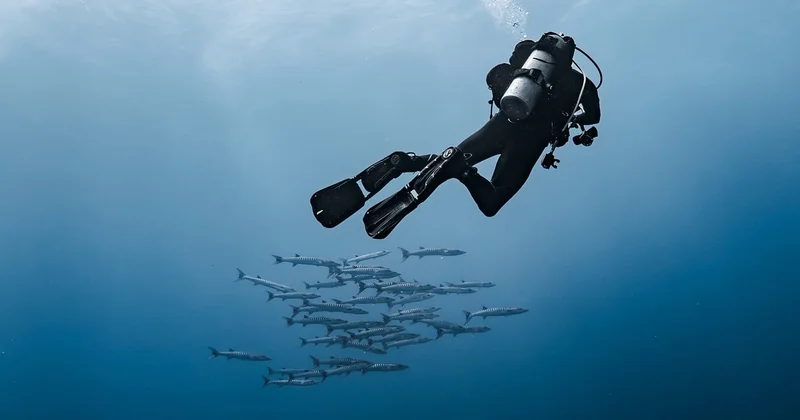
It's a conservative rule of thumb, not a law, and modern dive computers calculate your no-decompression limits far more precisely by tracking your actual depth profile, ascent rate, and surface intervals. Still, the 120 rule is worth knowing because it teaches the underlying logic: the deeper you go, the less time you have. Nitrogen absorption isn't linear with depth, which is why a dive to 30 metres gives you a fraction of the bottom time you'd get at 12.
One caveat — the rule is written in feet, so if you're diving in metric, the equivalent shortcut doesn't translate cleanly. Learn to read your computer instead, and treat the 120 rule as a sanity check on your planning rather than your primary guide.
What is the 1/3 rule in scuba diving?
The 1/3 rule is about gas management: you use one third of your air supply on the way in, one third on the way out, and keep one third in reserve for emergencies. It's a core principle in cave and wreck penetration diving, where you can't simply ascend to the surface when something goes wrong.
Here's where beginners get confused. The 1/3 rule does not apply to ordinary open-water recreational dives. On a standard reef dive, you turn around based on your pressure gauge and your dive computer, usually heading back with a comfortable margin — commonly 50 bar or 500 psi remaining on surfacing. You don't need the full third in reserve because the surface is always directly above you.
That said, the mindset behind the 1/3 rule is genuinely useful for travel diving. On a two-tank boat trip, knowing your air consumption rate helps you plan. If you breathe heavily — and most beginners do, especially in current — you'll burn through a tank in 35 minutes while the experienced divers next to you get an hour. That's normal, it improves, and it's the main reason beginners should never feel pressured to keep up with a group.
The logistics nobody mentions: medicals, insurance, and flying
Book your flights, book your course, and then forget the three things that actually cause problems.

Medical clearance
Most agencies require a medical questionnaire before certification. If you answer yes to anything on it — asthma, recent surgery, certain heart conditions, diabetes — you'll need a physician's sign-off. Get this done at home, before you travel. Trying to arrange a dive medical in a foreign language on the morning of your course is a miserable experience, and some centers won't accept a clearance issued by a doctor they can't verify.
Dive-specific insurance
Standard travel insurance frequently excludes scuba diving, or caps coverage at a depth well below recreational limits. If you're diving, you want a policy that explicitly covers it, including hyperbaric treatment. A chamber ride after a suspected decompression incident can run into five figures, and it's not the moment to discover your policy has an exclusion clause.
The no-fly window
A single no-decompression dive means waiting at least 12 hours before flying. Multiple dives across several days push that to 18 hours, and many agencies recommend a full 24. If you're flying home the day after your last dive, plan for a full day on the ground. I've watched people argue with dive shop staff about this, and the staff are always right.
What to buy versus rent on your first diving trip
Dive gear is expensive and, as a beginner, you don't yet know your preferences. Here's the split I'd recommend.
| Item | Buy or rent? | Why |
|---|---|---|
| Mask | Buy | Fit is personal; a leaking rental mask ruins dives |
| Dive computer | Buy | You need to understand your own device, not a different one each trip |
| Fins | Buy | Foot pockets and stiffness vary enormously |
| Regulator | Rent (for now) | Servicing costs and travel weight aren't worth it yet |
| BCD | Rent | You won't know your preferred style for 20–30 dives |
| Wetsuit | Rent | Thickness depends on the destination, not on you |
Baggage allowances are the hidden constraint. A regulator set and BCD add several kilograms, and most airlines count a dive bag as standard checked luggage. If you're doing a multi-stop trip, renting is often the practical choice regardless of what you'd prefer to own.
Diving solo, or starting later in life
One thing worth saying plainly: you do not need a partner to start diving. Dive centers match buddies as a matter of routine, and a large share of travelling divers are on their own. If you're over fifty and worried it's too late, the honest answer is that it usually isn't — plenty of people certify in their sixties, and the physical demands of warm-water recreational diving are modest. What matters is honest medical clearance and a willingness to dive within your limits rather than someone else's.
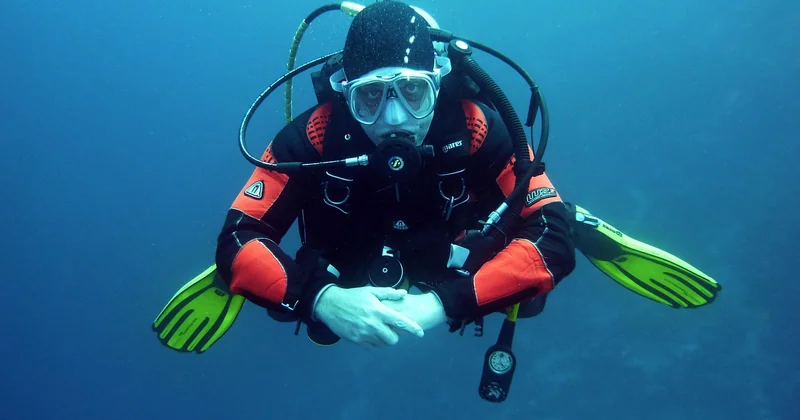
Group trips built around diving are the easiest entry point if the social side matters to you. You arrive, you're assigned a buddy, you eat dinner with the same people for a week, and by the end you've got dive contacts on three continents.
The realistic timeline for a travelling beginner
Here's what progression actually looks like, based on what I've seen and experienced.
- Days 1–4: certification. You'll feel clumsy and your air consumption will be terrible.
- Dives 5–15: buoyancy starts to click. You stop crashing into the reef. Air consumption improves noticeably.
- Dives 15–30: you can enjoy the dive and look at marine life instead of staring at your gauges.
- Dives 30–50: you start thinking about specialities, deeper dives, or a liveaboard.
- Dives 50+: you can genuinely relax and dive on autopilot.
So a two-week trip that gets you certified and adds eight or ten logged dives puts you in a solid position. A second trip the following year, and you'll be a competent recreational diver rather than someone who once did a course.
What actually matters
Diving while travelling isn't complicated. The barriers people imagine — fitness, age, cost, difficulty — are smaller than they look. The barriers that actually exist are administrative: the medical form, the insurance clause, the flight time you didn't leave yourself, the shop that rushed you through in three days to hit a quota.
Sort those out, and you're left with the thing that made you consider diving in the first place. Twenty minutes into your first proper reef dive, when your breathing has settled into a slow rhythm and you're hovering a metre above a coral head with no sound except the regulator, the whole course will feel like a bargain.
The water will be there next year too. Just don't leave the flight window calculation until the last morning.